India Investment For Global Investors

The Indian diaspora and global HNIs / UHNIs, NRI, SMSF, Investment company & Trust, Money manager, Asset manager, Financial planners, Fund Manager, Portfolio Managers, Superannuation funds, Alternative Assets and Hedge Funds are actively looking to participate in the India growth story.

We offer a variety of investment solutions for global investors looking to invest in India; through GIFT city. Our investment structure provides opportunity and access to Indian public markets, which is a vibrant avenue for investors seeking exposure to emerging markets. Our offering is only for eligible wholesale investors.

GIFT IFSC Structure

Inside the GIFT City Structure: Category III AIFs, IFSCA Regulation and Tax Treatment

India remains one of the world's most compelling growth markets. For non-resident investors seeking exposure to it, GIFT City (Gujarat International Finance Tec-City) — India's first International Financial Services Centre (IFSC) — provides a dedicated framework built specifically for international capital. India Growth Funds (IG Funds) is a vehicle that gives Australian wholesale investors access to this framework by investing into a Category III Alternative Investment Fund (AIF) domiciled in GIFT City. This article explains what that structure is, how it works, how it is regulated, how it is taxed, and who is eligible to invest.

What is a Category III AIF

An Alternative Investment Fund is a privately pooled investment vehicle that gathers capital from sophisticated investors to invest under a defined strategy. Indian regulation classifies AIFs into three categories. Category III AIFs are those that employ diverse or complex trading strategies — and may use leverage, including through investment in listed or unlisted derivatives. In practice this category covers long-short, absolute-return, multi-strategy and other actively managed approaches.

Within GIFT City, a Category III AIF is established under the IFSCA (Fund Management) Regulations as a Restricted Scheme (Non-Retail), launched by a Fund Management Entity (FME) registered with the International Financial Services Centres Authority. A key feature of this regime is that the regulator authorises and supervises the fund manager, rather than registering each fund product individually. Category III schemes may be structured as open-ended or close-ended vehicles.

IG Funds itself is not the AIF. It is a non-resident investor into a GIFT City Category III AIF of this kind — the Australian access vehicle through which wholesale investors gain USD-denominated exposure to Indian capital markets under a multi-nationally regulated structure.

How the Structure Works

IG Funds → GIFT City AIF → Indian Capital Markets

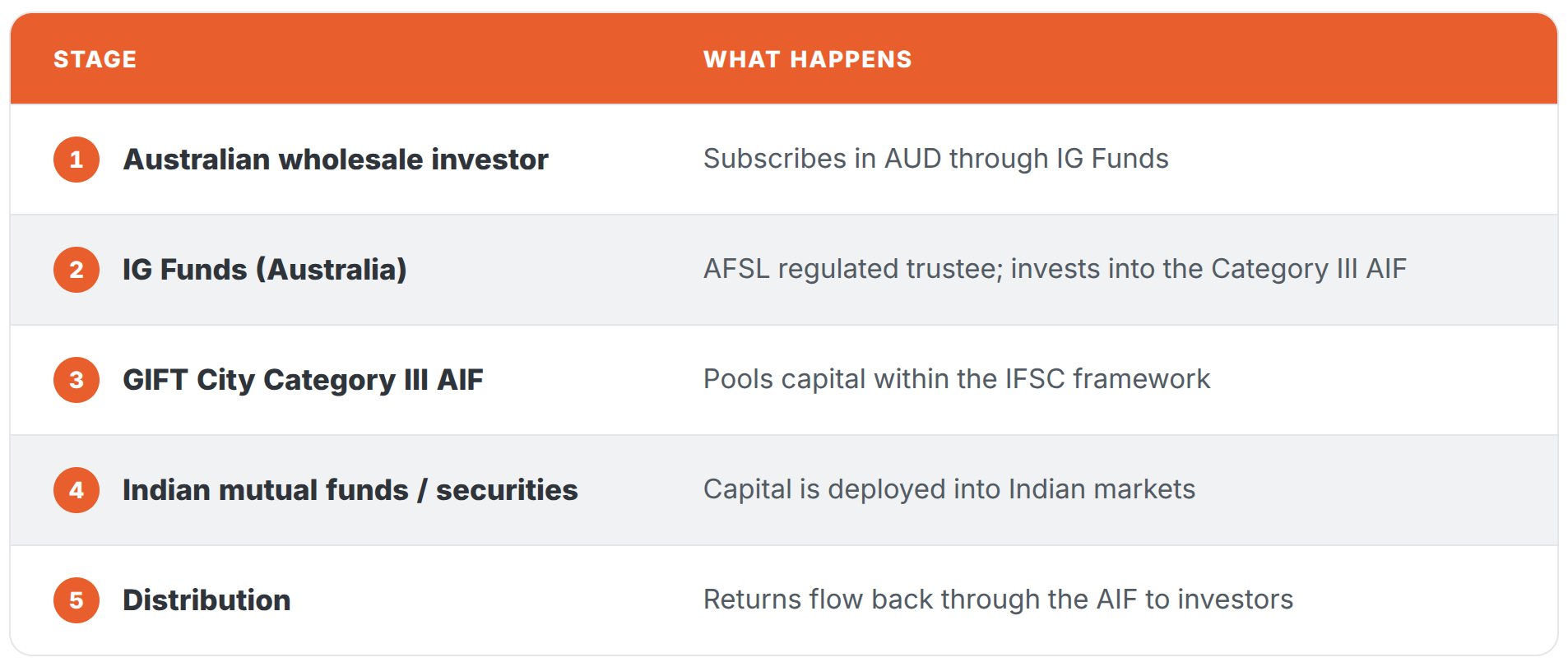
The structure follows a feeder-style flow that channels offshore capital into Indian markets:

  1. Australian wholesale investors subscribe in AUD through IG Funds, the Australian AFSL-regulated access vehicle.
  2. IG Funds invests into the GIFT City-based Category III AIF as a non-resident unitholder.
  3. The AIF, established within the IFSC framework, pools capital under professional management.
  4. The AIF deploys capital into Indian markets — into Indian mutual funds and other permitted securities.
  5. Returns generated in India flow back through the AIF to IG Funds and are distributed to investors.

The benefit is the ability to access India through a single structure built for international investors, with reduced administrative complexity and a more streamlined cross-border journey.

IFSCA Regulation & Protections

GIFT City is regulated by the International Financial Services Centres Authority (IFSCA), the unified regulator for India's IFSC established under the IFSCA Act, 2019. IFSCA consolidates, for the IFSC, powers that onshore are exercised separately by the RBI, SEBI, IRDAI and PFRDA. Investment funds in GIFT City operate under the IFSCA (Fund Management) Regulations, which replaced the earlier SEBI-administered AIF framework within the IFSC.

The regime builds in several investor-protection features:

  • Registered fund manager: the FME must be registered with IFSCA and meet prescribed net-worth and substance requirements.
  • Manager “skin in the game”: for a Category III scheme, the sponsor/manager must commit the lower of USD 1.5 million or 5% of the fund corpus, aligning the manager's interests with investors'.
  • Placement memorandum: the fund's Private Placement Memorandum (PPM) must be filed with IFSCA before launch.
  • Scheme-level requirements: minimum corpus, investment restrictions, disclosure, custody and audit obligations apply at the scheme level.

Note: Filing a PPM with, or registration by, IFSCA is for record and regulatory-oversight purposes. It does not constitute approval or endorsement of the scheme by the Authority, nor any assurance regarding returns or the safety of capital.

Tax Treatment — Section 10(4D)

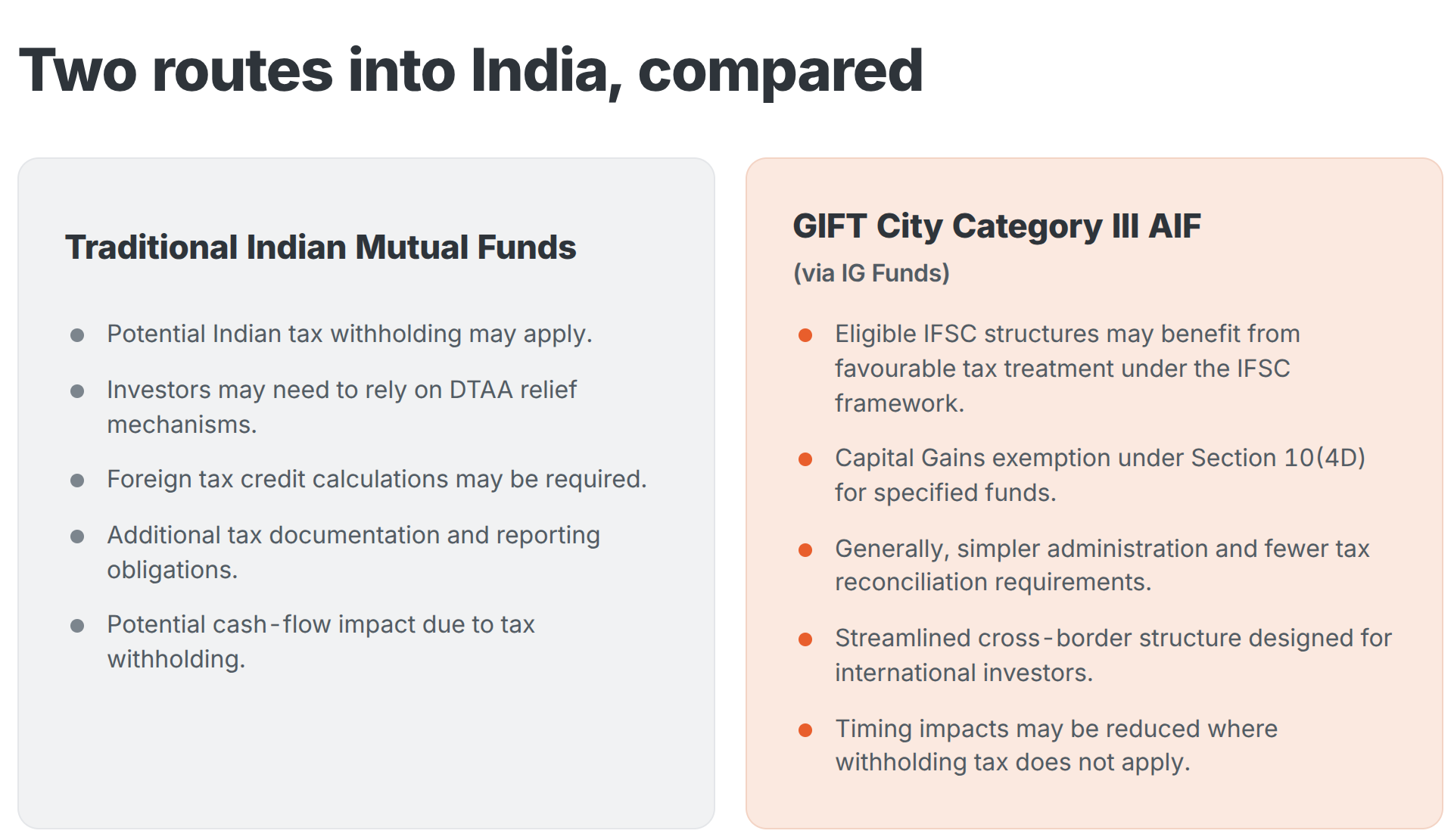
Many non-resident investors reach India through traditional mutual funds. Under that route, Indian tax may be withheld first, with relief claimed later through the India–Australia Double Taxation Avoidance Agreement (DTAA) and foreign tax offsets — a process that carries documentation and cash-flow friction. The GIFT City structure is designed to reduce that friction at source.

The relevant provision is Section 10(4D) of the Income-tax Act, 1961. It grants an exemption to a “specified fund” — a Category III AIF located in the IFSC, of which all units (other than those held by the sponsor or manager) are held by non-residents — a condition IG Funds satisfies as a non-resident unitholder.

The exemption applies to the fund's income from:

  • the transfer of securities (other than shares in a company resident in India);
  • securities issued by a non-resident, where that income does not otherwise accrue or arise in India; and
  • certain securitisation-trust income — to the extent attributable to units held by non-residents.

Two related provisions complete the picture: Section 10(23FBC) exempts unitholders on income received from such a fund and on the transfer of its units, and no Indian tax is required to be withheld on income that is exempt under Section 10(4D). Eligible non-resident investors may also be relieved of the requirement to obtain an Indian PAN or file an Indian return.

The practical effect: less focus on recovering taxes through treaty mechanisms, more focus on investing.

Investor-level tax obligations, including Australian tax on foreign income and capital gains, continue to apply. This is general information, not tax advice; investors should obtain independent, personalised tax advice. No particular tax outcome is guaranteed.


Who Can Invest in IG Funds — Wholesale Only

The GIFT City AIF carries a minimum investment of USD 150,000, which IG Funds meets at the fund level as the AIF's unitholder. Australian investors access the structure through IG Funds — at a considerably lower entry point, without needing to meet the AIF's USD 150,000 minimum themselves.

On the Australian side, IG Funds offers access to wholesale clients only, as defined under the Corporations Act 2001 (e.g. via an accountant's certificate confirming the net-asset or gross-income tests, or the minimum-investment test), and applies its own subscription terms and minimums. It is not a retail offer.

  • A minimum of AUD 25,000 for the investment into IG Funds; or
  • A systematic investment plan (SIP) thereafter of AUD 1,000 per month or AUD 3,000 per quarter, following the initial AUD 25,000 investment.

This structure is available to wholesale/professional and eligible non-resident and Australian investors only. Wholesale-client status must be confirmed for each investor before any offer is made. Nothing in this article is a retail offer, a recommendation, or personal financial advice.

Important Information

This article is general information only and does not constitute financial, tax or legal advice, nor an offer or invitation to invest. Any investment is subject to eligibility criteria and the terms of the relevant offer documents, which prevail over this summary. Investments carry risk, including possible loss of capital; past performance is not a reliable indicator of future performance. No person's circumstances have been considered when preparing this information. Prospective investors should seek independent advice appropriate to their circumstances.

Sources

IFSCA — ifsca.gov.in

GIFT City — giftgujarat.in

Income Tax Department (India) — Section 10(4D), incometaxindia.gov.in

IFSCA (Fund Management) Regulations — ifsca.gov.in