India Investment For Global Investors

The Indian diaspora and global HNIs / UHNIs, NRI, SMSF, Investment company & Trust, Money manager, Asset manager, Financial planners, Fund Manager, Portfolio Managers, Superannuation funds, Alternative Assets and Hedge Funds are actively looking to participate in the India growth story.

We offer a variety of investment solutions for global investors looking to invest in India; through GIFT city. Our investment structure provides opportunity and access to Indian public markets, which is a vibrant avenue for investors seeking exposure to emerging markets. Our offering is only for eligible wholesale investors.

Systematic Investment Plans

The Quiet Power of Consistent Investing: Understanding SIPs and Compounding

'Successful investing isn't about predicting the perfect time to enter the market—it's about staying invested long enough for time to do the heavy lifting.'

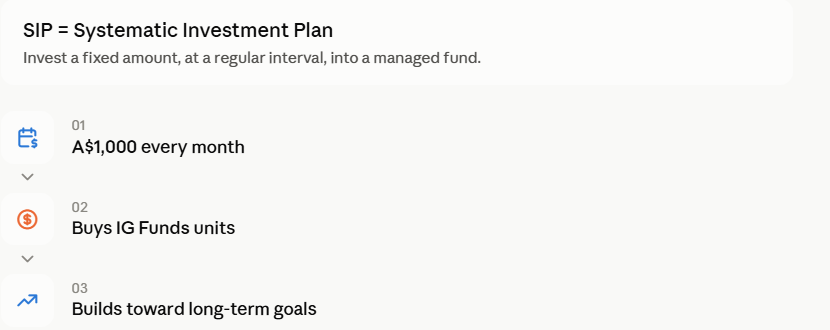
Markets rise, fall, and often surprise even the most experienced investors. For wholesale investors considering long-term investment strategies, consistency is often discussed as an alternative to attempting to time market movements. That's where a Systematic Investment Plan (SIP) comes in. Rather than investing a large sum all at once, an SIP allows investors to contribute a fixed amount at regular intervals—whether monthly, quarterly, or at another chosen frequency. This disciplined approach helps investors gradually build wealth while navigating changing market conditions.

How Does an SIP Work?

Think of an SIP as putting investing on autopilot.

Once you choose a fund and a fixed investment amount, contributions are automatically invested at regular intervals. Each contribution purchases units of the fund based on its prevailing Net Asset Value (NAV). Since NAV fluctuates with market movements, the number of units purchased also changes over time.

For example, imagine you want to invest AUD 12,000. You could invest the entire amount as a lump-sum investment or spread it into regular SIP contributions, starting with AUD 1,000 per month.

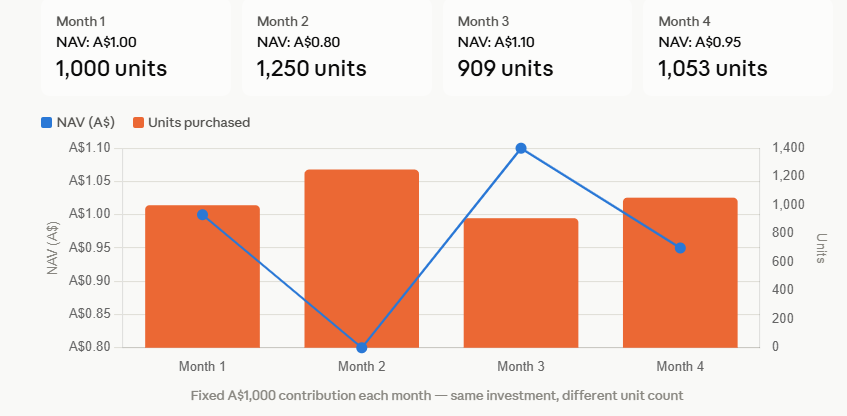
If the fund's Net Asset Value (NAV) is AUD 1, your first SIP contribution of AUD 1,000 will purchase 1000 units. If the NAV changes the following month, the same AUD 1,000 will buy a different number of units. Over time, this disciplined approach helps average the cost of investing across market cycles, reducing the need to rely on a single market entry point.

Different Types of SIPs

Investors can choose an SIP structure that best fits their financial goals and cash flow.

  • Top-up SIP: Allows investors to gradually increase their investment amount over time, making it suitable as income grows.
  • Flexible SIP: Offers the freedom to increase or decrease contributions depending on changing financial circumstances.
  • Perpetual SIP: Continues until the investor decides to stop, without requiring a predefined end date.

These options allow investors to align their investment strategy with different life stages and financial objectives.

Why Do Investors Choose SIPs?

One of the biggest advantages of an SIP is that it encourages consistency instead of emotional decision-making.

Regular investing helps smooth the impact of market volatility by spreading investments over time, reducing the pressure to predict market highs and lows.

SIPs also encourage long-term financial discipline. Small, recurring investments can gradually accumulate into meaningful wealth, especially when combined with the power of compounding—where returns are reinvested, allowing investments to generate returns on previous returns.

The flexibility to pause, increase, or adjust contributions further makes SIPs adaptable to changing financial circumstances while supporting long-term goals such as retirement planning, education funding, or wealth creation.

For investors exploring India's long-term growth story, a disciplined investment approach often aligns well with the country's evolving capital markets. Through IG Funds offers SIP investments starting from AUD 1000/month for wholesale investors.

The Power of Compounding: When Your Money Starts Working for You

If there is one concept often described as the "engine" of long-term investing, it is compounding.

At its core, compounding is simple: instead of withdrawing the returns your investments generate, you reinvest them. Over time, those returns begin earning returns of their own, creating a snowball effect that can significantly accelerate wealth creation. The real secret, however, isn't just earning returns—it's giving those returns enough time to grow.

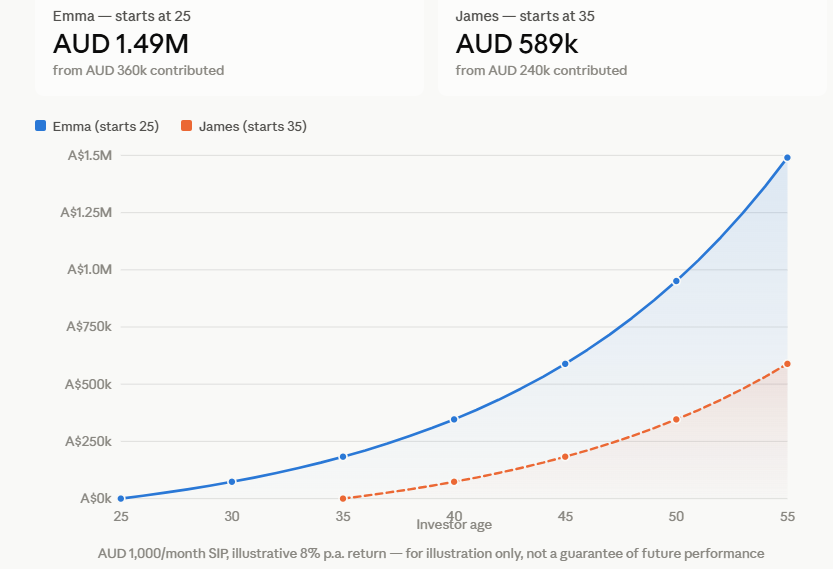
Consider two investors, Emma and James. Emma begins investing AUD 1000 every month at the age of 25, while James starts the same investment at 35. Assuming both earn similar long-term annual returns (we will use a rate of 8%, but this is illustrative only, and not indicative of any expected future returns), Emma's portfolio is likely to grow substantially larger not because she invested more each month, but because she gave compounding an extra decade to work.

The lesson is clear: when it comes to compounding, time is often more valuable than the amount invested.

Why SIPs and Compounding Work So Well Together

A Systematic Investment Plan (SIP) naturally complements the power of compounding.

Every regular contribution increases your investment base. Instead of making a one-time investment, you continue adding to your portfolio, allowing both your contributions and your previous earnings to generate future returns.

Because earnings remain invested, they begin creating returns of their own, gradually accelerating the pace of growth. While the progress may seem modest in the early years, the impact becomes increasingly noticeable over longer investment horizons.

SIPs also benefit from cost averaging. When markets decline, the same investment amount purchases more units, and when markets rise, it purchases fewer. Over time, this helps smooth out the average purchase cost while allowing compounding to continue working in the background.

For long-term investors looking at India's structural growth story, consistency can often matter more than perfect market timing.

Connect with us at IG Funds to learn more about SIP.

Important Disclaimer

Important: This article is intended for wholesale investors only and is provided for general informational purposes. It is not financial advice, and you should consider your own circumstances before making any investment decisions.